Understanding Your Bill
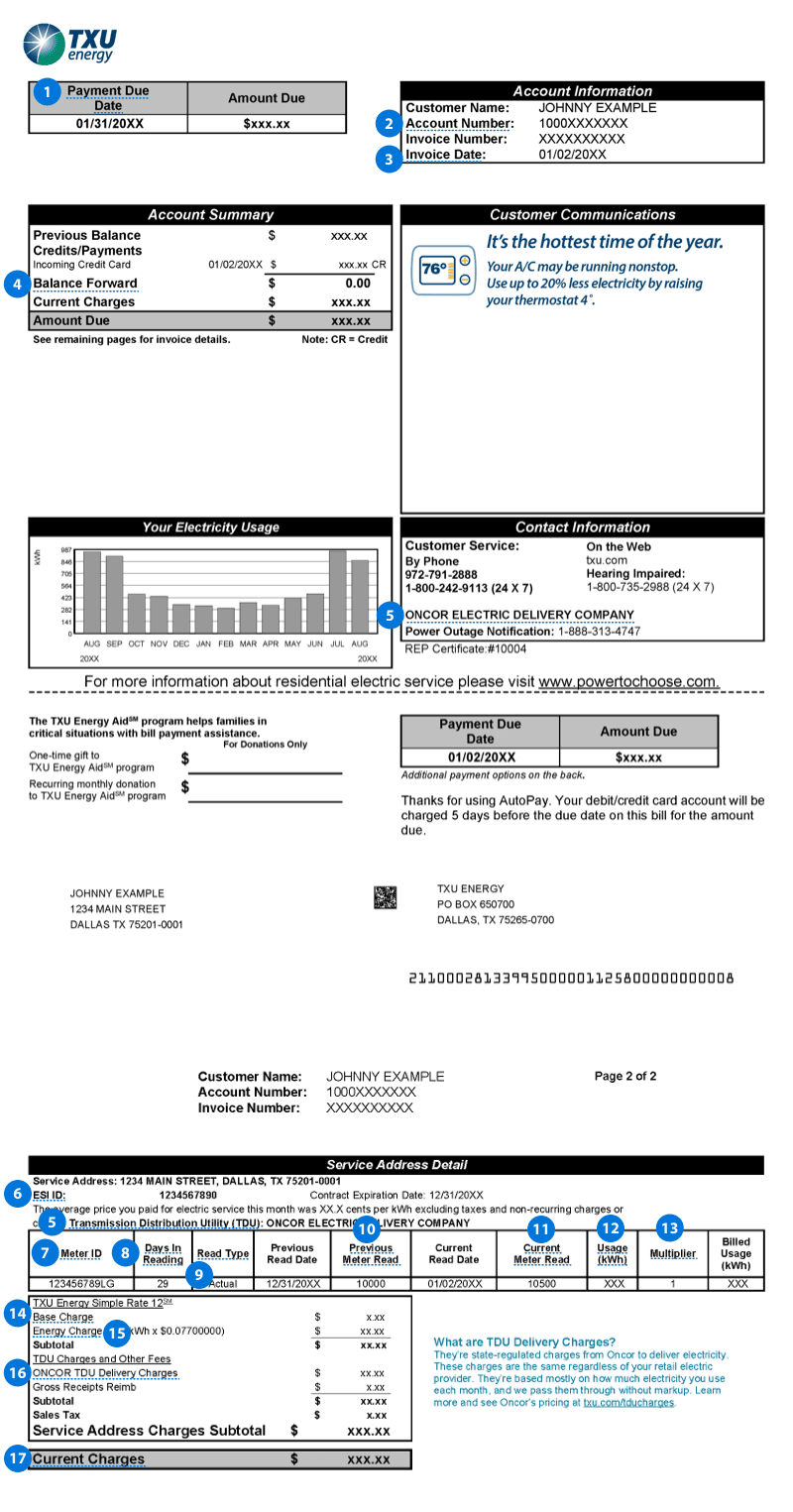
Take a look at what’s on your TXU Energy bill and what it means for you. Each line helps you see what you’re paying for — so it’s clear all year long.
The main charge is for the electricity you use each month, based on your plan and how much energy you use. Standard delivery charges go to your local utility (TDU) to keep power flowing safely to you – these are passed to you without markup, regardless of your provider. All providers charge TDU delivery fees, as well as taxes that are set by state and local agencies.
You might also see added products or services you chose, as well as credits or discounts to help you save. We break it down clearly, so you always know what to expect and can make the most of your plan.
View our full Glossary of Billing Terms
Top Terms on Your Electricity Bill
-
1. Payment Due DateThe payment due date is the day by which we must receive your electricity bill payment to avoid any late payment fees. A provider may charge a one-time late payment fee, not to exceed 5% of the past due balance.
-
2. Account NumberAn account number is a unique number that identifies your TXU Energy electric service account. If you have more than one service address, you’ll have more than one account number. If you need to contact us, have this number ready. You’ll also need this number to sign up for MyAccount, or if you pay your bill in person, at authorized payment locations.
-
3. Invoice DateThe invoice date on your electricity bill is the date the invoice was generated. That bill only covers electricity usage before that date – it doesn’t cover usage between the Invoice Date and the date you receive the invoice.
-
4. Balance ForwardBalance Forward or Accumulated balance is the amount you owe on previous TXU Energy bills that has carried over to your current bill.
-
5. Transmission and Distribution Utility (TDU)The Transmission and Distribution Utility (TDU) is the company that owns or operates the equipment or facilities that transmit and distribute electricity to your home or business. The TDU is also responsible for reading your meter and establishing prices related to your delivery charges (TDU Delivery Charges) shown on your bill (if applicable).
-
6. ESI IDESI ID or Electrical Service Identifier is an identifier used by the industry to uniquely identify the home or business.
-
7. Meter IDMeter ID or meter number is the number identifying the meter at your service location. A meter is a device that measures your electricity usage.
-
8. Days in ReadingDays in Reading is the number of days between your current meter read and your last meter read, which determines the length of your billing cycle.
-
9. Read Type
A “read type” on an electricity bill tells you how your electricity usage was measured for that billing period. It explains whether the usage came from an actual meter reading, an estimate, or another adjustment.
Common read types include:
- Actual – Usage was recorded from a real meter or smart meter reading.
- Estimated – Usage was estimated because a meter reading wasn’t available.
- Adjusted / Corrected – Usage was updated to reflect a prior estimate or fix an error.
This helps explain why your usage or charges might look different from one month to the next.
-
10. Previous Meter ReadPrevious Meter Read is the meter reading from the previous bill for your reference.
-
11. Current Meter ReadThe current meter reading shows the total amount of electricity your meter has recorded as of the date it was read. Because the meter keeps a running total and doesn’t reset each month, the previous month’s reading is subtracted from the current reading to calculate how many kilowatt-hours (kWh) you used during just this billing period. This reading is provided by the TDU and is typically captured when the meter is read, which occurs every 28–32 days.
-
12. Usage (kWh)Usage is measured in kilowatt-hours (kWh), which is the standard unit for measuring electricity usage, equal to 1,000 watt-hours. Usage is the amount of electricity (kWh) used in a month, calculated by subtracting the prior month's meter reading from the current month's meter reading.
-
13. MultiplierFor some meters, the actual amount of energy used is too large to be recorded and the meter displays a fraction of the actual energy used. A multiplier is then applied to the difference between the current and previous reading to determine your actual energy usage.
-
14. Base ChargeA base charge is a fixed charge collected during each billing cycle regardless of your energy usage. If your plan includes a base charge, it will appear as a separate line item on your bill.
-
15. Energy ChargeA charge based on the electricity (kWh) consumed during your billing period.
-
16. TDU Delivery ChargesThe total amount charged by a Transmission and Distribution Utility (TDU) for the delivery of electricity to your location through the TDU's poles, wires and other facilities, not including discretionary charges. These delivery charges are set by the TDU and passed through to you on your bill without markup.
-
17. Current ChargesCurrent charges are the cost of the electricity you used during this most recent billing period. This includes your regular service charge, energy use, and sales tax, but does not include any past due amounts, late fees, or extra charges—those are listed separately and added to your total amount due if applicable.
Everything You Need to Know
Stay in Control
Keep tabs on how much electricity you use at any time, view and pay your bill, and more in MyAccount.

TDU Charges, Explained
Transmission and Distribution Utilities (TDU) charge every electricity provider to transmit and distribute electricity to your home or business. We pass these fees on with no markup.

Here for you 24/7
Questions? Give us a call anytime at 800-818-6132. Need extra time to pay your bill?
Learn more.More Helpful Info

Learn how to calculate the average price per kilowatt-hour (kWh) using your Electricity Facts Label or your bill.