We're getting things ready for you....

If you’re reviewing your plan details or comparing electricity plans, you may notice an average price per kilowatt-hour (kWh) listed on the Electricity Facts Label (EFL). This price is meant to help you compare plans, but it may not exactly match what you see on your bill. The Public Utility Commission of Texas (PUC) defines how average prices are calculated on both the EFL and customer bills to ensure consistency and transparency across providers.
This page explains what the EFL average price means, how it’s calculated and how to use it correctly when choosing or reviewing a plan.
The average price per kWh on your EFL is based on exactly 500, 1000, or 2000 kWh of usage, but your actual usage may vary. It can help you compare electricity rates side by side, understand how pricing changes at different usage levels and choose a plan that best fits your home. It’s a comparison tool and meant to be representative – not a prediction of your exact monthly bill.
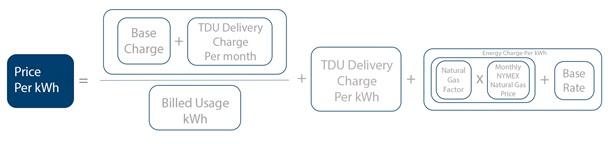
It's calculated using:
Your EFL pricing does not include taxes and any non-recurring fees in this calculation. This creates a sample average price to show how a plan may perform at different usage amounts.
It’s normal for your bill’s average price to differ from the EFL price because your bill is based on actual usage, while the EFL is based on specific usage amounts.
Your EFL price assumes:
Your actual bill reflects:
Because real usage rarely is exactly 500, 1000 or 2000 kWh, your bill’s average price can be higher or lower than the EFL examples — even though your energy rate hasn’t changed.
Not necessarily. Some plans are designed to work best at certain usage levels. If your usage is higher or lower than the EFL examples shown, the average price will change.
That’s why EFLs show multiple usage levels — to help you see how a plan behaves across different scenarios.
For best results, focus on the usage level closest to how much electricity you normally use and use the EFL to compare plans, not to estimate an exact bill.
If your usage changes, your average price will change too — even though your plan rate remains the same.
The average price per kWh on your EFL is a planning and comparison tool, not a bill forecast. Differences between the EFL price and your bill are common and expected, especially when usage or billing days vary.
Understanding how the EFL works can help you choose the right plan and avoid surprises later.
Indexed Plan Price Calculation:
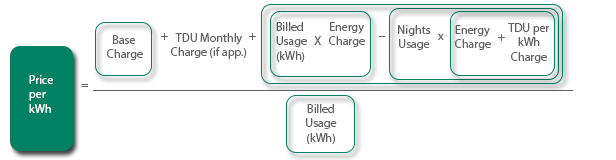
If you have an indexed plan like TXU Energy Free Nights®,you can use the formula below and your EFL to calculate your current average price.
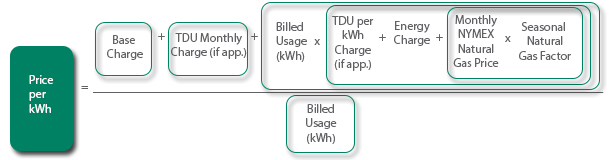
For plans like TXU Energy MarketEdgeSM, you can use this formula and your EFL to calculate your current average price. The monthly NYMEX Natural Gas Price is $3.00 (October 2026) vs. $2.91 (September 2026).
For plans like TXU Energy AutoSaverSM, you can use this formula and your EFL to calculate your current average price.